
What is our curriculum?
The Wymering School provides ‘a community which learns creatively to become knowledgeable, self-aware, independent and happy.’
To help bring our curriculum statement to life please watch our series of videos which explain each area of our curriculum and show them in action
All students at The Wymering School have social communication differences, including ASD, ADHD and associated behaviour, with 88% demonstrating significantly raised levels of anxiety and presenting concerns around their mental health (SCAS October 2023). Pupils arrive with significant gaps in learning and with low levels of attendance. Key Stage 2 comprises Years 5, 6 and 7 students. Providing a static class model provides greater stability for those children starting at Wymering, allowing us to identify and fill gaps in their learning which prepares them well for moving in to secondary at Year 8.
Our students have all come from different educational and personal backgrounds, however common themes across our student body include; limited independence and experience in community settings often due to their high needs; low belief and confidence in their own abilities as a learner and as an individual, often combined with past educational trauma; limited understanding of personal and health needs and how to successfully meet these; high vulnerability both in person and online and significant mental health concerns.
As is true of many people with social communication differences, our young people can have very fixed thought patterns, difficulties understanding the perspectives of others, and challenges expressing themselves in the way they would like to be understood, all of which makes them vulnerable.
The school values of Togetherness, Resilience, Enthusiasm and Kindness (TREK) are present in our every day actions and learning. They reflect the qualities that students and staff agreed would help overcome barriers, take up challenges and promote a positive mindset. The vast majority of our students arrive with mental health concerns and very low self-esteem, in addition to their significant social communication differences. We begin our curriculum using togetherness and kindness to allow students to feel safe and wanted in school, providing them with positive experiences in order to build their trust with the school, friendships with their peers, and to start to see themselves as learners who can be successful. We employ a variety of play-based teaching methods so that staff can assess and progress learning, while students do not feel under pressure

Students at The Wymering School receive a unique, personalised and bespoke integrated therapeutic curriculum which is flexible enough to meet their changing needs to ensure that they are getting the emotional and social support that they need, as well as ambitious academic challenge when they are ready for it. As a result of this blended curriculum approach students develop the knowledge to access the wider world beyond school, as informed, independent and capable young adults.

As a result, our curriculum breaks down into 5 key areas, each of key importance across students’ journeys with us.
To meet the make up of our students Wymering has developed a curriculum which is right, relevant and purposeful. It is underpinned by five priorities.
These priority areas ensure that when students leave us at the end of Year 11 they will;
Learning Skills
- Have gained independent thinking and learning skills that can be transferred to adult life
- Have a love of learning and a desire to continue learning in an area which inspires them
- Have a range of nationally recognised qualifications which demonstrate their ability.
Mental and Physical Health
- Are aware that everyone has mental health and the strategies that work for them to support their mental health
- Are aware of the importance of a healthy lifestyle for their physical and emotional wellbeing
- Feel confident and self-assured and have a healthy sense of self awareness
- Know how to access support for their physical and mental health
Careers and Future Focus
- Talk about their ambitions for the future and be proud of their achievements
- Know how the skills and knowledge they are being taught can apply to their future lives.
- Know the options that are available to them when they leave Wymering
- Feel supported in life and in making the transition to the next stage of their lives
Community and the Wider World
- Support the values of the school and make a positive contribution to the local community
- Demonstrate care and understanding towards others and respect other cultures, religions, gender and difference
- Are aware of opportunities in the local community and how they can contribute to their local community
- Are aware of world events, the impact they have on others and can show an understanding of how others’ views may differ from their own and how to manage this.
Skills for Independence
- Be creative and able to manage change
- Feel confident and able to communicate with a wide range of people
- Be able to access the community safely and independently
- Know how to manage money, a house and independent travel safely and successfully.
- Know what support is available and how to access it.
As they start to see the value of themselves as a person and a learner, students become able to cope with feedback and returning to a task to make improvements. For many pupils if there is too much of an increase in academic demand leads to a decrease in mental health due to a fear of failure. As such this demand needs to be assessed continually and on a very personalised basis to ensure that those who are ready for increased challenge are receiving it. Those who need decreased demand are being noticed and the challenge adjusted accordingly.
As pupil’s grow their trust in the school, we start to build their enthusiasm for learning, for life and for their futures, providing them with experiences and challenges to will push them out of their comfort zone but leave them excited and enthused for the next steps.
We deliver a blended curriculum and staff teams, academic, pastoral and therapeutic work together to ensure that teaching and learning accounts for their individual needs and learning styles. When pupils feel comfortable it is then that they will learn best.
How we deliver our curriculum
Our approach to learning across the school is practical and creative. Student learn and retain information most effectively when they can understand why they need to learn it and by taking part in practical activities around the task as illustrated by Edgar Dale’s Cone of experience.


Whilst the national curriculum is the basis of how we have sequenced knowledge and skills, each individual student receives a bespoke, holistic curriculum. English, Reading, Maths and PSHE are core subjects. PSHE is broken down into three strands – Personal Development, Life Skills and Mental Health and Emotional Wellbeing. Our five curriculum areas are taught holistically across the curriculum with students encouraged to see the connections between them and what they are learning. See below for an example of how the science curriculum is covered and connected within each of our learning areas.
Science
Learning Skills – Rooted in the science national curriculum, but also considering metacognition and the science behind learning to support students in understanding what learning is and how they learn best. We have used the National Curriculum for Science to create the foundation for our Wymering Science Curriculum, taking into account the areas of most relevance and importance for our students to include a broad and balanced knowledge and understanding.
Mental and Physical Health – Mental health lessons include learning on neuroscience and how chemical changes in the brain can alter mental health. PE lessons include biological information as well as health and fitness.
Careers and Future Focus – Students will be exposed to a wide range of career opportunities within the field of science but will also be encouraged to understand how science impacts many roles which may not initially be viewed as scientific. They will be able to explore science based apprenticeships, internships and college courses as they learn about which routes are best suited to their needs
Community and the Wider World – Students will consider the impact of science on their own lives, locally within Portsmouth and on a larger scale within the UK and the wider world. They will be encouraged to consider not only the benefits of science for others but also the ethical implications of scientific advances
Skills for Independence – Students will be able to see how they can use science to increase their own independence and that of others but also to be aware of the risks and implications of the application of science in their everyday lives and the importance of asking questions
Our curriculum is rooted in the National Curriculum objectives as this provides a broad and balanced framework. We have personalised it to meet the needs of our students, to ensure that they are getting their additional needs met in line with their EHCP, as well as closing academic gaps, providing appropriate challenge and allowing personalisation of the curriculum to enable students to meet objectives using their interests to support their learning. This has involved highlighting the National Curriculum objectives that we feel are the most vital for our students to ensure that they leave The Wymering School with the knowledge, skills, understanding and qualifications to be successful in the next stage of their education journey.
Students are encouraged to find creative methods to solve problems. Many of our pupils are incredibly creative thinkers, but can have fixed and rigid thought patterns which challenge their creative thinking. We encourage students to consider multiple responses to a challenge to encourage flexibility of thought. Staff understand the importance of making learning fun and are able to embed learning tasks in activities which students find enjoyable, as this keeps their anxiety low. Staff will often involve student’s special interests to support their learning. Dunn and Delafield- Butt (2016) presented research which demonstrated a strong positive connection to the use of a child’s special interests and academic progress. This in turn enables students to access and retain learning and supports our value of Enthusiasm.

The Deputy Head leads on Curriculum Development and the Assistant Head on Progress. The pastoral and therapy team work alongside staff to ensure that their input has an active role within the day to day curriculum for individual pupils. Across long term planning, topic planning and daily planning, phase teams use the Assess, Plan, Do, Review and Adjust cycle to maximise opportunities for student progress.


Active Learning
Students are encouraged to be ambitious and hold high aspirations for themselves. Community based learning gives our pupils a meaningful space in which to apply their learning and skills. We take students out into the community wherever possible, as well as inviting the community in to work with us. Work experience is a valuable feature of KS4 with students working towards this from KS2 gradually building their skills and confidence to prepare them . Once again, using Edgar Dale’s Cone of experience, we are able to use practical experiences to support students in embedding their learning and being able to recreate it in multiple settings.

All students are able to experience running an enterprise project, visiting local colleges and educational establishments, travel training and visits from local and national employers and people in a variety of occupations to support student’s learning and ambition.

It is our aim that all students in all year groups should be able to experience residential visits, starting with one night locally in Key Stage 2 and building to a longer trip further away in Key Stage 4 in order to support students’ independence, challenge their thinking, and to encourage their resilience.
Future focus is a priority, from when students arrive in Year 5. They are encouraged to talk about their ambitions, research possibilities and links are always made between what students are learning and how it can be applied to the future.
Learning Balance
As a school we embrace new and adaptive technology and recognise it as a primary method that our students use to engage with and access the world, while always encouraging safety and proper use. While we celebrate the opportunities this provides, we also understand the importance of balance for our students. To ensure we create this balance, we offer a comprehensive adventure learning program, ensuring students regularly experience whole days offsite engaged in team-building activities and outdoor learning. Through activities such as coasteering, mountain biking, and watersports, we aim to nurture resilience, collaboration, and a connection with nature, equipping students with a well-rounded education that complements their digital experiences.
Key Stage 2
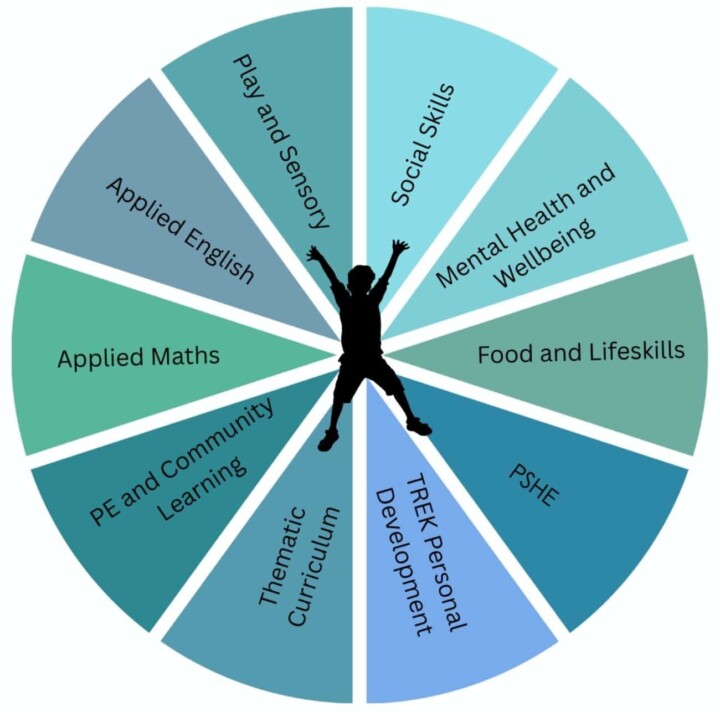
Key Stage 2 pupils follow a thematic curriculum. A thematic curriculum allows students to develop transferable skills, make connections between subjects, consolidate skills, challenge their understanding and express their learning in a variety of ways. This is supported by research from Ye and Xu (2023) who stated that their “study discovered that an interdisciplinary thematic learning environment centred on real world challenges, fosters students’ creative thinking while also encouraging group communication and collaboration. Students also gain critical thinking thorough questioning and critique”.
Topics have a subject/s which are the main driver. This ensures that all subject areas are addressed across the course of the year and the phase, offers pupils variety and creates opportunities to make links between subjects and apply existing knowledge. English, Maths, PSHE, Mental Health, Lifeskills, PE and Food are delivered through every unit.
Key Stage 3
Within Key Stage 3, which comprises Years 8 and 9, we continue with thematic learning using our personalised curriculum based on the National Curriculum. This allows for a clear connection between Key Stage 2 and Key Stage 3 objectives and learning follows a natural progression. While it is important to show the connection to the learning completed in the Primary phase, it is also important to prepare students for the requirements of a Key Stage 4 curriculum. As such we being to teach English and maths as discreet subjects and we offer ASDAN short courses and a BTEC Level 1/2 in Home Cooking to allow students to experience the requirements of working to exam board criteria, using the skills and knowledge they built the foundations of in the Primary phase. (see also, KS2 to KS4 Curriculum Progression document)

Key Stage 4
Our Key Stage 4 curriculum is a natural progression from the learning and experiences within KS3, with a focus on preparing for post 16 education. Within Key Stage 4, subjects are offered at different levels to ensure that students are working at a level which challenges them, but at which they can also achieve a positive outcome. We have a balance of academic qualifications, and qualifications which encourage a Level 1/2 standard of learning and also provide students with practical learning for life and support their transition to life beyond Wymering.

How this benefits our students
Students develop sufficient knowledge and application to address their unique needs and empower them to become independent, confident, and capable young adults. It’s impact can be observed across a range of areas, reflecting the core values of our approach: Togetherness, Resilience, Enthusiasm, and Kindness (TREK).
Learning Skills:
Students gain critical thinking, problem-solving, and independent learning skills that are essential for adulthood. They develop a love for learning and confidence in their abilities, leading to a deeper engagement in their education and a desire to pursue further studies or vocational training. Our focus on personalised learning helps students achieve nationally recognised qualifications, demonstrating their potential and preparing them for future success.
Mental and Physical Health:
Throughout our curriculum, not just in mental health lessons, we support students mental and physical well-being. Students learn to identify strategies that work for them to manage their mental health, recognise the importance of a healthy lifestyle, and develop a strong sense of self-awareness and self-confidence. This approach significantly reduces anxiety levels and equips students with the tools to navigate challenges both in school and in life. We aim to embed the phrase “Do Good, Feel Good” as this works positively with our students.
Careers and Future Focus:
The impact of our curriculum is evident in students’ growing aspirations and their ability to articulate their future ambitions. They learn how the skills and knowledge they acquire at The Wymering School apply to real-world scenarios, which motivates them to set goals for their future. Students feel supported in making informed decisions about their next steps in education or employment, fostering a smooth transition to life beyond school.
Community and the Wider World:
Our curriculum instils a sense of social responsibility and cultural awareness in students, encouraging them to contribute positively to their local communities. They learn to respect diversity, engage with different perspectives, and understand global events, making them more empathetic and well-rounded individuals. Students leave our school with a clear sense of how they can impact their surroundings and the confidence to do so.
Skills for Independence:
One of the most significant impacts of our curriculum is its emphasis on building life skills. Students develop the ability to communicate effectively, manage their finances, navigate community spaces safely, and adapt to changes. By the time they leave us, they are equipped to live more independently and know where to seek support when needed.
The Wymering Curriculum’s comprehensive approach ensures that every student, regardless of their starting point, is given the opportunity to increase their knowledge, academically, emotionally, and socially. Real world learning is embedded within topics. This promotes a balance between new experiences, increased student voice and exposure to a wide range of opportunities, which hold value for life beyond school. The success of our students is a testament to the curriculum’s focus on fostering a sense of belonging, building resilience and encouraging a passion for lifelong learning. The curriculum goes beyond the academic, supporting children to achieve their best and prepare our students not just to face the challenges of today but to thrive in the world of tomorrow.
Davis, B. and Summers, M. (2015) ‘Applying Dale’s cone of experience to increase learning and retention: A study of student learning in a foundational leadership course’, QScience Proceedings, 2015(4), p. 6. doi:10.5339/qproc.2015.wcee2014.6.
Gunn, K.C. and Delafield-Butt, J.T. (2016) ‘Teaching children with autism spectrum disorder with restricted interests’, Review of Educational Research, 86(2), pp. 408–430. doi:10.3102/0034654315604027.
Ye, P. and Xu, X. (2023) ‘A case study of Interdisciplinary Thematic Learning curriculum to cultivate “4C skills”’, Frontiers in Psychology, 14. doi:10.3389/fpsyg.2023.1080811.
Watch our curriculum videos